
PhD Research
Published:
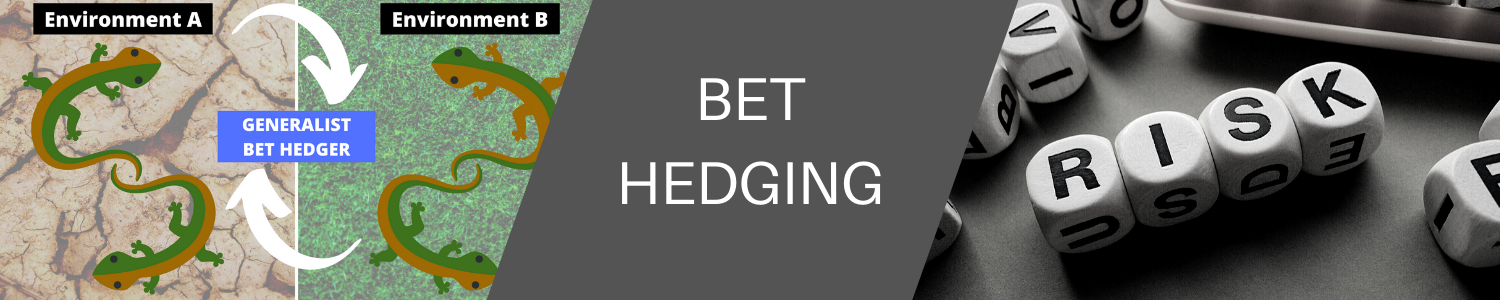
Life’s a gamble: how evolution plays the odds and reduces risk
My work with the Weinreich Lab utilizes a variety of computational methods to explore the of bet hedging, a strategy for reducing risk in unpredictable environments.
Environments can be unpredictable, and in the face of uncertainty organisms must choose how to best maximize their chances of survival. One way organisms can cope with environmental variability is by “hedging their bets,” as winning something is better than losing everything. Bet hedging is a widespread strategy for risk reduction where a population will suffer some cost in order to insulate themselves from the risk of a worst case scenario. Bet hedging is mathematically defined as a trade-off where a population will lower its average fitness in order to also lower its fitness variance. Common examples include:
- Delayed seed germination in annual plants: randomness in when a seed will germinate leads to the maintenance of a seed bank, ensuring that in a really bad year, some seeds will survive. (Venable 2007)
- Bacterial persistence: some bacteria can randomly switch between a fast-growing but antibiotic susceptible phenotype and a slow-growing phenotype that can survive longer periods of antibiotic pressure. (Balaban 2004)
- Mouthbrooding in fish: some fish keep their eggs in their mouths as a form of parental care, which protects eggs from predation and other risks. However, mouthbrooders have fewer eggs, as there is limited space for eggs in their mouths. (Weller 2022)
Chapters
- Beyond the (geometric) mean: stochastic models undermine deterministic predictions of bet hedger evolution
- [American Naturalist](https://www.biorxiv.org/content/10.1101/2023.07.11.548608v2
- Bet hedging is a ubiquitous strategy for risk reduction in the face of unpredictable environmental change where a lineage lowers its variance in fitness across environments at the expense of also lowering its arithmetic mean fitness. Classically, the benefit of bet hedging has been quantified using geometric mean fitness (GMF); bet hedging is expected to evolve if and only if it has a higher GMF than the wild-type. We build upon previous research on the effect of incorporating stochasticity in phenotypic distribution, environment, and reproduction to investigate the extent to which these sources of stochasticity will impact the evolution of real-world bet hedging traits. We utilize both individual-based simulations and Markov chain numerics to demonstrate that modeling stochasticity can alter the sign of selection for the bet hedger compared to deterministic predictions. We find that bet hedging can be deleterious at small population sizes and beneficial at larger population sizes. This non-monotonic dependence of the sign of selection on population size, known as sign inversion, exists across parameter space for both conservative and diversified bet hedgers. We apply our model to published data of bet hedging strategies to show that sign inversion exists for biologically relevant parameters in two study systems: Papaver dubium, an annual poppy with variable germination phenology, and Salmonella typhimurium, a pathogenic bacteria that exhibits antibiotic persistence. Taken together, our results suggest that GMF is not enough to predict when bet hedging is adaptive.
- Balancing the risks of mating: biogeographic evidence of cleistogamy as a bet hedging strategy
- Preprint
- Annual plants are some of the best know bet hedgers; annual plants adopt a range of bet hedging strategies from delayed seed germination, to seasonal variance in germination phenology, to high ovule:fruit ratio. One possible example of bet hedging is cleistogamy, a strategy where plants produce some proportion of “closed” flowers that obligately self. Cleistogamous flowers are a “sure bet” conservative phenotype, as they are energetically inexpensive and do not rely on pollinators. In contrast, chasmogamous flowers, or “open” flowers, maintain genetic variation via outcrossing. Both dimorphic (aka diversified) and complete (aka conservative) cleistogamy have been observed. Models and empirical studies have struggled to prove whether cleistogamy is actually bet hedging, as well as the adaptiveness of the chasmogamous phenotype. Does the geographic distribution of the presence of cleistogamy provide clues as to when it is expected to evolve? What drives the evolution of complete vs. dimorphic strategies?
- Drivers of the evolution of conservative vs. diversified bet-hedging strategies
- Bet hedging strategies are classified as either conservative or diversified. Conservative bet hedging “play it safe” by having all individuals adopt a generalist phenotype that can better survive stress conditions. Diversified bet hedgers “don’t put all their eggs in one basket” by stochastically switching between different phenotypic states. Both conservative and diversified strategies have evolved across the tree of life, and both strategies have been observed in closely related taxa. This raises the question of why some populations evolve to adopt conservative bet-hedging strategies while others become diversified. Do some types of environmental change (i.e. temporal vs. spatial) favor certain bet hedging strategies? Does mutational accessibility or life history play a role? Or is it all random chance?
Mentees
- Neal Yin (Computational Biology Class of 2024), mentored 2022 - 2024
- 2023 Maria L. Caleel ’87 Memorial Undergraduate Biology Research Fellow
- Studied the evolution of amphicarpy in hog peanuts through simulations and greenhouse experiments
- Amdrew Fogarty (Neuroscience Class of 2026), mentored 2024
- Assisted with a comprehensive literature review on the diversity of bet hedging strategies found in nature
- Anwen Lin (Computational Biology Class of 2023), mentored 2021 - 2022
- Modeled the impact of bacterial persistence on treatment outcome