
Brooke the Bat’s Wild Night
Published:
Download English Version Here!
About the Book
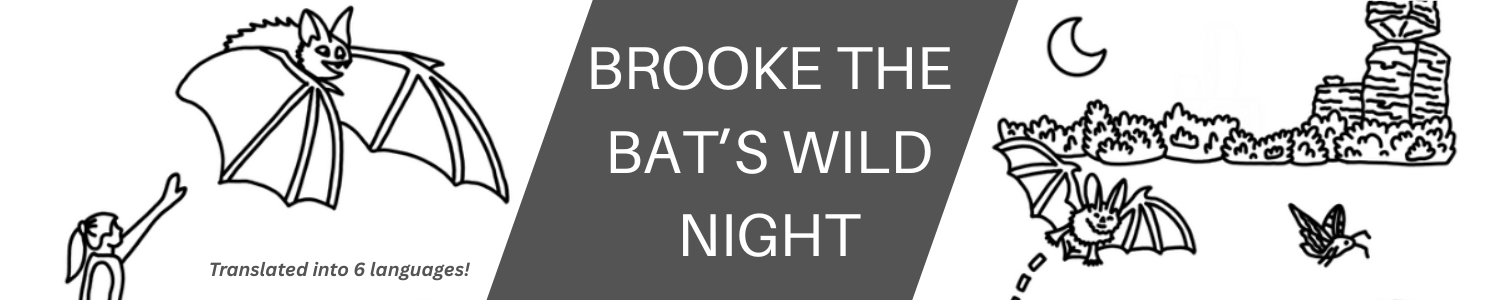
This book was made in partnership with the Swartz Aeromechanics & Evolutionary Morphology Lab at Brown University, which studies the structure and motion of bat flight. In particular, Brooke Quinn helped develop the story.
Other members of the Swartz Lab translated this book into six other languages.
- Spanish Version - translated by Alberto Bortoni
- Chinese Version - translated by Xiaozhou Fan
- French Version - translated by Clément Champiat
- Japanese Version - translated by anonymous undergraduate researcher
- Korean Version - translated by Rea Yoh
- Tamil Version - translated by Sakthi Swarrup J
For Educators
Working with educators from a diverse range of disciplines and locations, this books was developed with the Next Generation Science and Common Core Standards in mind. I hope that from homeschool to public school, you will find my books both fun and educational.
This coloring book meets the following Next Generation Science Standards:
- K-LS1.1: Use observations to describe patterns of what plants and animals (including humans) need to survive.
- 1-LS1.2: Read texts and use media to determine patterns in behavior of parents and offspring that help offspring survive.
- 2-LS4.1: Make observations of plants and animals to compare the diversity of life in different habitats.
- 3-LS4.3: Construct an argument with evidence that in a particular habitat some organisms can survive well, some survive less well, and some cannot survive at all.
- 4-LS1.1: Construct an argument that plants and animals have internal and external structures that function to support survival, growth, behavior, and reproduction.
- 4-LS1-2: Use a model to describe that animals receive different types of information through their senses, process the information in their brain, and respond to the information in different ways.
- 5-LS2-1: Develop a model to describe the movement of matter among plants, animals, decomposers, and the environment.
- MS-LS1.4: Use argument based on empirical evidence and scientific reasoning to support an explanation for how characteristic animal behaviors and specialized plant structures affect the probability of successful reproduction of animals and plants respectively.
- MS-LS1.5: Construct a scientific explanation based on evidence for how environmental and genetic factors influence the growth of organisms.
- MS-LS1.8: Gather and synthesize information that sensory receptors respond to stimuli by sending messages to the brain for immediate behavior or storage as memories.
- MS-LS2.1: Analyze and interpret data to provide evidence for the effects of resource availability on organisms and populations of organisms in an ecosystem.
- MS-LS4.2: Apply scientific ideas to construct an explanation for the anatomical similarities and differences among modern organisms and between modern and fossil organisms to infer evolutionary relationships.
And the following English Language Arts Common Core Standards:
- 5.2: Determine two or more main ideas of a text and explain how they are supported by key details; summarize the text.
- 5.3: Explain the relationships or interactions between two or more individuals, events, ideas, or concepts in a historical, scientific, or technical text based on specific information in the text.
- 5.4: Determine the meaning of general academic and domain-specific words and phrases in a relevant text.
- 5.7: Draw on information from multiple print or digital sources, demonstrating the ability to locate an answer to a question quickly or to solve a problem efficiently.
- 3.10: By the end of the year, read and comprehend informational texts, including history/social studies, science, and technical texts.
- 3.7: Use information gained from illustrations (e.g., maps, photographs) and the words in a text to demonstrate understanding of the text (e.g., where, when, why, and how key events occur).